
Calanais Standing Stones
Callanish, Isle Of Lewis, Outer Hebrides, HS2 9DY
To provide you with the best experience, cookies are used on this site. Learn more


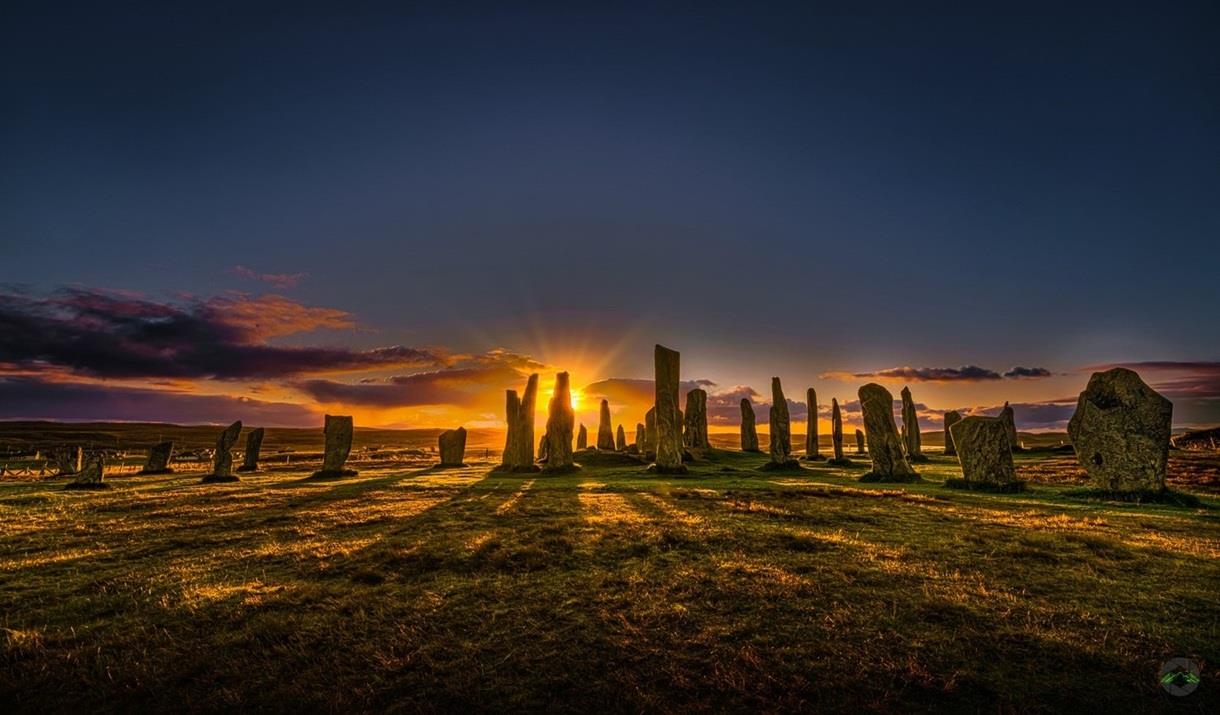
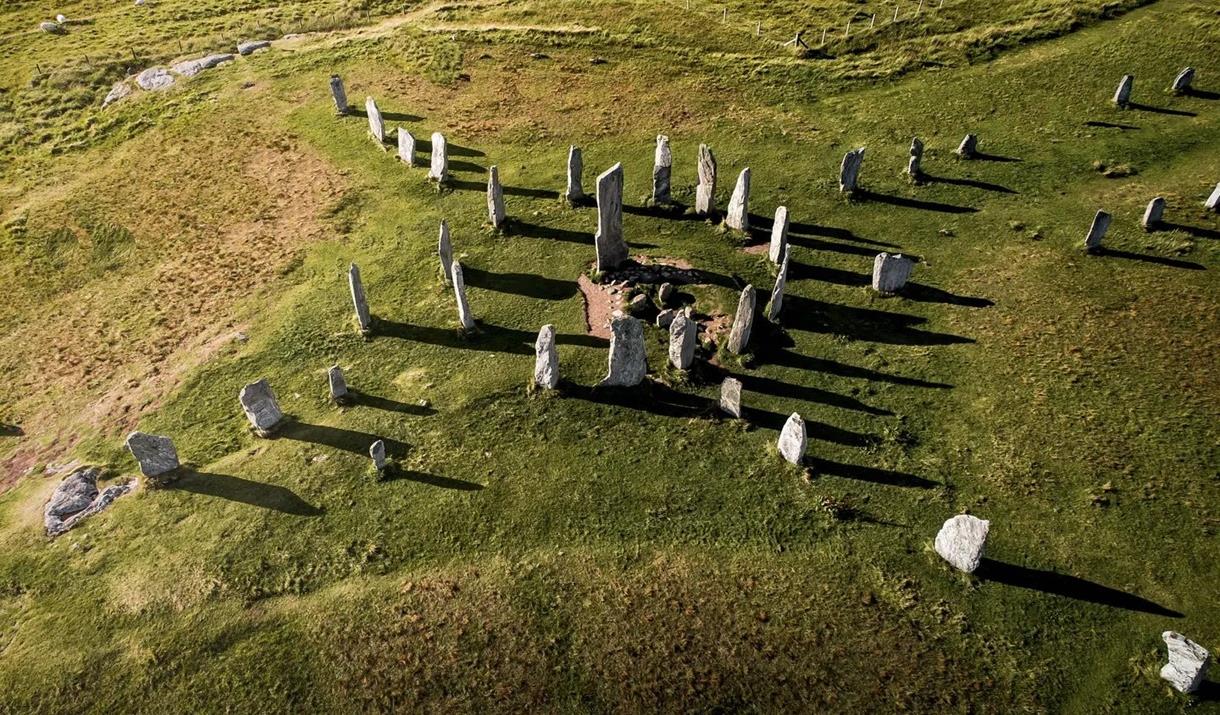
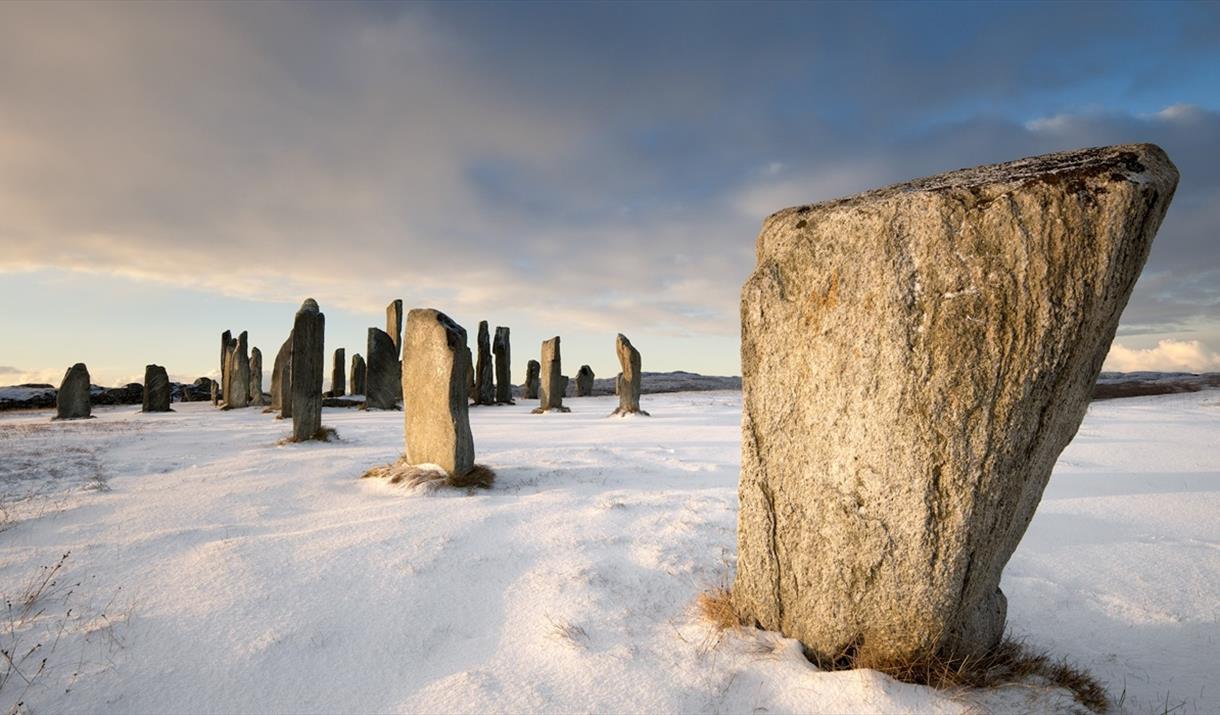
A visit to the stones of Calanais is always stunning, and can be quite a different experience at varying times of the year, and in varying light conditions. One of the most remarkable aspects of the site is its relationship to the landscape within which it sits, from its dominating ridge it has uninterrupted views to the distant horizon around 360 degrees. It provides a perfect opportunity to observe the rising and settings of moon and sun and other celestial bodies, and there can be little doubt that this was one of the central functions of Calanais.
It is believed by many that the hills on the southern horizon, known locally as Cailleach na Mòintich (Old woman of the Moors) resembles a recumbent female figure, which may have had great resonance in the minds of early farmers who depended on the fertility of the earth. It is also known that, at this latitude, both the sun and the moon demonstrate wide variance over their cycles. The moon in particular ranges dramatically over an 18.6 year cycle, and the stones may have been partly conceived to take particular notice of this phenomenon. Today again, many people gather at the critical time, hoping to observe the moon rise out of the body of Cailleach na Mòintich, skim low over the horizon, set behind the hill of Cnoc an Tursa, and reappear at the foot of the monolith at the centre of the circle, seeing this is as an ancient manifestation of the idea of "birth, life, death, and rebirth". The last lunar major event was in 2006/7: the next will be 2025.
Even before 1857 when the site was stripped of its overburden of peat, returning the stones to their full Neolithic splendour, Calanais has attracted the attention of visitors and antiquarians. Limited modern excavations have been carried out there since the 1970s, first to understand more fully the meaning and development of the site, and then to locate the settlements and fields of the farming peoples who built the stones and presumably worshipped at them. The story has started to be told, but there is still so much yet to understand.
The standing stones at Calanais are the centrepiece of a ritual landscape filled with other, related stone circles and settings, just as a great cathedral relates to its many smaller churches and chapels. Closest at hand are Calanais II, III and IV.
Visit the new Calanais Standing Stones and Visitor Centre which is now open for a preview period and offers an exclusive opportunity to explore the centre’s state-of-the-art facilities, shop, café, and new exhibition where you can learn, relax, and explore. As part of the preview season, you will also have the opportunity to share your feedback and help shape the visitor experience. For more information and to book, visit Calanais Standing Stones and Visitor Centre.
Download the Callanish walking leaflet here.
| Visitor Centre and Calanais Standing Stones (1 Jan 2026 - 31 Dec 2026) | ||
|---|---|---|
| Day | Times | |
| Monday - Saturday | 09:00 | - 17:00 |
* Access to the Calanais Standing Stones is via the Calanais Visitor Centre between 9-5pm Mon - Sat. Book tickets on the Calanais website. Outwith these times, access to the Calanais Standing Stones is free via the path at the Calanais Viisitor Centre.
The new Calanais Visitor Centre is now open for a preview season ahead of our official…
Remains of an oval stone ring with 5 standing stones and at least two fallen ones dating…
A captivating stone circle of 12 standing stones, linked to Celtic mythology and the…
The Hebridean Soap Company produces hand made soap, candles abnd beauty products in the…
Explore Calanais IV, a compact Neolithic stone circle with panoramic views over Loch…
Other points of interest on Bernera and the surrounding land include the bridge, standing…
My Website will offer images of the place you love. I aim to capture the warmth of the…
This is the best preserved and most visited broch in the Outer Hebrides. It occupies a…
Dancing Flower Crafts designs and handmakes one off, unique Harris Tweed® gifts and…
An Iron Age house which was reconstructed in 1999 following a storm in 1993 which…
Island Darkroom is a contemporary photography gallery and studio in the heart of the Isle…
Gearrannan (Garenin) is a restored blackhouse village on the west side of the Isle of…
It is easy to imagine that you have stepped back in time to experience the way of life in…
A beautiful little gallery situated just above the sandy beach at Dalbeg, on the west…
Camas na Clibhe (Cliff beach) is a quartz sand beach situated on the Valtos peninsular in…



© Outer Hebrides Tourism (Trading) 2026. Registered in Scotland SC 201113. All Rights Reserved
Ratings Powered By